Sunday, April 22, 2012

Girl + Truck = Okay, Boy + Doll = Homosexual?

So often we talk about wanting little girls to have the same opportunities as little boys, but perhaps in some cases boys are lacking the opportunity that girls have.  This, in my observation, is occurring mainly in play. 
Some parents are especially progressive in trying to protect their children from the ill effects of gender stereotyping, for example the parents of Sasha Laxton, whom as we have discussed in previous blogs, is being raised completely "gender neutral".  Where is the line though?
It seems we draw a very distinct line.  In the "gendered play" department girls seem to have an edge over boys. It is relatively commonplace and accepted for girls to play with trucks, participate in sports, or just generally get dirty, traditionally past times for boys. The girl is labeled a "tomboy" and not a second thought is given.
Unfortunately boys are not afforded the same flexibility.  Boys are confined to traditionally masculine activities.  Any foray into more feminine activities, such as having tea parties or playing dress up is met with resistance and often fear by adults. 
So what is it about boys being "girly" that is more upsetting than girls being "boy-y"?

Strangely enough I suspect the answer lies in a patriarchal past.  Historically, the male experience has been understood as the human experience.  For example, early psychological studies were done almost exclusively on men, then assumed to apply to all people. So the idea of boy's toys being toys for all children is not that much of a stretch for the mine. So, girls can play with trucks and no one bats an eye, but boys cannot play with dolls because dolls are feminine. Within this way of thinking, boys who are feminine are not what they ought to be, they are weak, or weird, or homosexual, but one things if for sure, they are not normal and this makes us uncomfortable.
Or perhaps what causes discomfort is that we don't know what they are.  We have the word "tomboy", but there is no word for a boy who likes to do "girly things" that isn't derogatory.  Boys who like more traditionally feminine activities are subject to names like "pansy" or assumed to be homosexual earning any number of slurs. Perhaps we are limited by our language in this way.  Since we have no way to describe these behaviors in a positive way we assume they are bad and must be curtailed.
But what do you think? How is being a "tomboy" different from a "pansy"? Share your comments below.

Wednesday, April 18, 2012

Sugar and Spice and Not Very Nice

There have always been, and probably always will be, mean girls but has the saturation of social media and technology amongst young people made it easier for them to be even meaner?  Stories of mobs of girls filming themselves beating other girls and posting the videos to YouTube or Facebook leave audiences horrified.  How could girls, made of sugar and spice and everything nice, do something so seemingly evil?
Scholars have long documented the need young adolescent girls feel to be accepted by and into social groups.  Being well liked and having status is of the utmost importance and so often tactics of relational aggression, manifest in gossip, social exclusion and manipulation, and rumor spreading (Willer 416).
These issues have long existed but the rise of social media makes promoting one's own status by engaging in these practices just so much easier.  It is as if social power is a commodity.  There is only so much of it so it must be earned or stolen through social interaction either by building oneself up, or tearing another girl down.
The problem is there is now little escape from such relational aggression, short of total social isolation.  Because of the pervasiveness of social media technology acts of relational aggression no longer occur as isolated incidents among a few in the community but rather as waves that sweep over one's entire social network.  With the click of a button relationally aggression is shared with the world, ensuring that it is almost inescapable for the recipient.
Social media provides a lot of social power, power which adolescent girls in particular may lack in other aspects of their lives.  But for all the concern given about male oppression of females it seems that the oppressed has become the oppressor.  Girls have use their new found sense of agency in social media to tear down other girls instead of oppressive structures.

The whole situation is a little bit horrifying, should not be cause for dismissal of social media.  Since these technologies are new there is a learning curve.  I suspect that parents, unfamiliar with the medium have struggled to find realistic ways to deal with children and social networking.  I think however, we can put hope in the idea that social media has the potential to be empowering and not just demeaning.  Once again, media education of both adolescents and parents is key to a resolution of the situation.  Girls in particular need to learn how to channel their power to build up without tearing down and social networks are the first place to do that.


 References
Willer, E. K., & Cupach, W. R. (2008). When “Sugar and Spice” Turn to “Fire and Ice”: Factors Affecting the Adverse Consequences of Relational Aggression among Adolescent Girls. Communication Studies, 59(4), 415-429. doi:10.1080/10510970802473674
http://parentingteens.about.com/b/2008/04/19/girls-fighting-youtube-videos-are-mean-girls-getting-meaner.htm
http://www.nypost.com/p/entertainment/too_cruel_for_school_CljzKtibmTTODrdsI4caAO
http://mg.co.za/article/2011-01-21-mean-girls-get-meaner-online

Monday, April 16, 2012

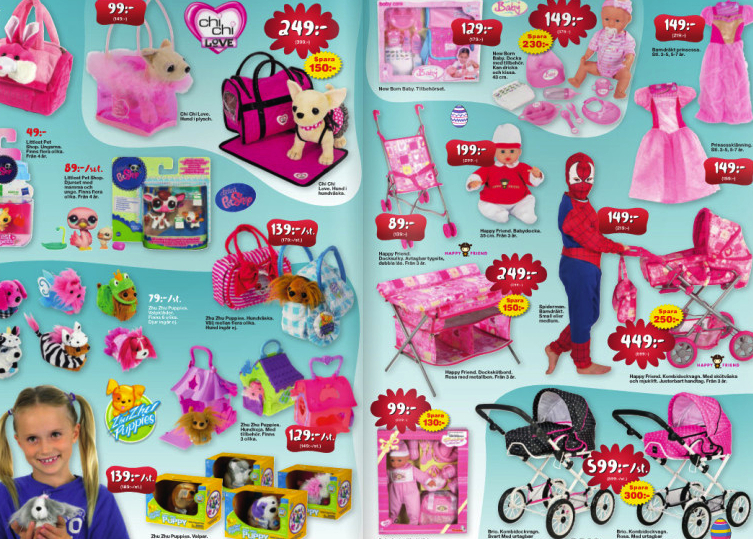
What if Spiderman likes Pink?

I was reading this interesting article recently and I wondered, What about gender makes us feel so uncomfortable? 
One Swedish toy company is marketing against gender stereotypes and doing it on purpose.  A scan circulating from their new catalog shows a little boy in a Spiderman costume posing with a hot pink baby carriage. It's harmless enough, but many are up in arms about it.  But what's the big deal?

Personally, I lapsed into a fit of giggles when I saw the ad.  I still have to ask why it is so funny that a boy plays with a baby carriage.  It is actually a relatively common site to see a father pushing his child in a stroller.  Since children often seek to imitate the behavior of caregivers it should not be unreasonable for a child of either gender to want to play with a baby doll and toy stroller, especially if their are infants in their family. 
But note, no one is upset about little girls playing with baby dolls and toy strollers.  As a matter of fact little girls are encouraged to aspire to be parents while the idea of a little boy having such an aspiration is utterly horrifying to some.
Young boys seem to get the short end of the stick when it comes to gendered toys and pasttimes.  Girls can play with trucks, play sports, and watch super hero cartoons and merely be labeled a "tomboy".  On the other hand a boy who wishes to have tea parties, dance ballet, and play with Barbies invites ominous predictions of homosexuality.
The toy company's goals are admirable.  Any child should be able to play with any toy, regardless of the gender it is assigned.  But the article points to a bigger cultural development.  Apparently there is a substantial movement in Sweden to completely eliminate the concept of gender altogether. 
This, to me, sounds foolish.  Yes, gender is socially constructed but that does not mean it is imaginary or that it serves no function.  It has implications based on both biology and history that can't be ignored. 
I believe in equality between men and women.  Equality, however, in the sense that I use it, does not mean that men and women are exactly the same and ignoring gender differences is just as harmful as perpetuating gender stereotypes . 
There are certain experiences that are uniquely female, for example the ability to bear children.  Ignoring this part of female experience denies the extra difficulties women can suffer as child bearers, working mothers, or victims of sex crimes.  That is not even to mention the fact that women have long relied on other women to provide practical advice through life events, such as childbirth, that men can never offer, no matter how well intentioned or educated, simply for the reason that they will never experience it.
To ignore these differences sounds dangerously like a return to patriarchy, a slippery slope towards a "one story" view of humanity. The goal should be to treat all genders equitably, with appreciation for their different experiences, and respect for their equal ability to contribute.
So what do you think about this Swedish toy company's push against gender stereotypes?  Are they beneficial or detrimental?

Sunday, April 15, 2012

The Birds, the Bees, and the Internet

It's a classic tale; Boy meets girl. Boy and girl flirt. Boys asks girl... to be friends on Facebook?

Adults are increasingly perplexed by communication via the internet, and with good reason.  Technology and online social networking has changed so quickly from it's onset it is hard for even computer literate adults to keep up with the changing paradigms.  The general consensus is usually that kids do it wrong.  Don't they know it is better to get to know people in real life? Why can't they do things the right way, like we did before Facebook and Twitter and email?
But, the reality of the situation is that internet social media are not going away.  Every day they are becoming a bigger part of children's and adolescent's relational developement.  In light of that perhaps we should examine internet social media as a different, not subservient, means of socializing.
A 2010 study shows that online interactions may provide an important role in young people's development of cross-gender relationships. Despite common fears of parents most adolescents in the study did not seek to have offline interactions with those they meet in chat rooms.  Moreover, the on social networking sites the participants frequently expressed that they did not accept friend requests from those they did not know offline, thus eliminating much of the worries over "Dateline: To Catch a Predator" type incidents.

Still it is the relationship that youth have with social media that is troubling to many parents.  It may sound strange, even alarming to hear that young people have "relationships" with media but "relationship" is perhaps a better way to describe the nature of the nature of social media use than "consumption".
Young people's use of social media is a relationship in that they contribute to the medium (Facebook, chat room, etc.), the medium is influenced by their contribution and gives them something in return.  One of the possible thing that young people receive in return is the means to achieve their social goals, goals that would otherwise be unattainable, or more difficult to attain without the use of social media.
Girls for instance, were found in the study to use internet social media as an opportunity to experiment with different behavior. This is not to say that they took on another identity, in fact quite the opposite.  They explored facets of their own identities they may have been more difficult in their offline lives because of cultural norms or family expectations.
In the 2010 study's look at cross gender conversations on internet chat rooms found that girls took advantage of the fact that they could not be judged based on their physical appearance, an all too common concern for young girls.  They were able to express themselves with more self confidence and assertiveness than they were normally able to in offline life.This was, in fact, noticed by boys in chat rooms who were often confused by the ways girls talked to them online, sometimes thinking the girls didn't like them. 
This is a minor social discomfort, which has the potential for cultural impact.  Since young people are often still developing their expectations for the opposite gender, challenging these expectations early may provide more open mindedness for offline gender related cultural changes (ex.: fights against gender discrimination).  Such interactions are not likely to occur offline where  there are more concrete disadvantages to going against cultural norms. 
Additionally, adolescent cross-gender conversations online help on personal levels, giving boys and girls more dynamic views of the opposite gender, which will help them as they continue on into higher education, the working world, and adult family life. 
Yes, it is wise to educate children and adolescents about the dangers online, and the importance of things like fresh air, exercise, and physical human interaction, but social media are beneficial in their own way.  As it turns out, they might not be the unproductive time suck we thought they were.


Waechter, N., Subrahmanyam, K., Reich, S. M., & Espinoza, G. (2010). Youth Connecting Online: From Chat Rooms to Social. At the Interface / Probing the Boundaries, 151-178.

Thursday, April 12, 2012

Is Gender Bad?

There are a wealth of legitimate concerns about the gender stereotypes presented in media.  Many have suggested that the social constructed nature of gender (as opposed to biological sex) sets up gender distinctions to be inherently unequal (Berkowitz 2010).  So what is to be done about it?  A growing trend that is getting a lot of media coverage is parents raising their children as "gender neutral".  By now most people have heard about Beck Laxton and Kieran Cooper, a British couple who decided to raise their child, Sasha, as gender neutral.  The couple was finally forced to reveal the sex of their child this January when he started attending primary school.  The general public seems to reject Laxton and Cooper's approach to protecting their child, but why? Let us explore.


 What is right with it?
Agency
A significant positive aspect of the Laxton-Cooper approach is that little Sasha has a lot more agency than most children have.  He is permitted a great deal more choices when it comes to clothing, toys, and general self expression.  It is hard to think of a way in which this could be a bad thing.  Because Sasha's parents hoped to shield him from gender stereotypes they were hyper conscious of the choices they offered him, being sure to provide diverse options.
Free from Stereotypes
 Previous blogs have discussed how adults often unconsciously sexualize children.  Sasha may have less of this to deal with since his sex has been somewhat dissociated from his gender.  Media images of sexualized females or hyper sexual males might have a lesser effect on him because of his limited gender identification.


What is wrong with it?
Identity
While it is true that gender stereotypes are often harmful or oppressive, being part of a gender group can have positive effects.  The problem here is not so much that Sasha does not have a gender but that the rest of the people in his world do.  For better or worse, children (and humans in general for that matter) separate themselves based on shared aspects of identity.  They then develop friendships and bonds, often over shared struggles that surround the social and physical aspects of being male or female.  Though it is entirely possible for a people to bond over things other than gender my worry would be that Sasha (or other such "gender neurtral" children) would be at a social disadvantage, with no preexisting model of how they might (or might not) fit into society.  This might end up having the reverse effect his parents intended.  Instead of being limited by gender he would be limited by lack of gender. Is that any better?


Does it even matter?
In the end, I praise Laxton and Cooper's motives but question their approach.  Their child will still be exposed to gender stereotypes no matter how much they try to shield him.  Do they really think that Sasha will not be influenced by images such as these?


  Ignoring a problem has never fixed it and ignoring gender, or the societal implicaitons of it, won't make gender stereotyping go away.  Media outlets will continue to produce stereotypical images that even children, like Sasha, will be exposed to.

  I would suggest that education about gender stereotypes starting from a young age would be ultimately more effective.  This is also an approach that if Laxton and Cooper were so inclined they could have promoted in their child's school and in their community... unfortunately the community now views them as the looney parents who don't know their child's gender.
How would you/ do you try to protect your own children from gender stereotyping?

http://www.dailymail.co.uk/news/article-2089474/Beck-Laxton-Kieran-Cooper-reveal-sex-gender-neutral-child-Sasha.html

Wednesday, April 11, 2012

"Hey kid, Stop Acting so Childish!"

What does sexy mean to a tween? Lots of parents are worried about just that.  Popular discourse often worries about kids being exposed to adult media.  A kid should not watch a rated R movie or a crime drama but what about when it is the kids' media that is too adult?
There is constant worry about media images effect on young people, young girls in particular. One parent and blogger, Sara Sarasohn, expressed worry about just that problem.  Sarasohn mused about how she was not allowed to play with Barbie as a child because of her mother's fear of the effects on body image the doll would have and how this pales in comparison to the suggestive clothing being marketed to children today.
Perhaps, however, the problem is not the media but rather adults.

Since adults are usually the creators of media for children they are the ones who fuse their adult sense of what is appealing into children's media, and for that matter in everyday products, like clothing, that are not typically looked at as "media".  For example, young girls are often criticized for dressing too sexy.  Adults blame the influence of popular music, television, and other media examples that sexualize women.  But these sexualized identities are present from an early age because of the media images and products they are exposed to daily.  Many of these images may fail to make significant distinction between girls and women which means that styles and attitudes that appeal to adult women are subsumed by girls as part of their adoption of gender.  The question is one of timing: Are girls adopting a woman's identity too soon?
One  might say that children's preferences for sexualized media reflect their sexual development.  While it is true enough that children are capable of making a lot of decisions independently, adults have the power to limit the range of a child's perspective, resulting in a limited scope for the child's decisions.
Sarasohn points to the difficulty she has in finding clothing that does not sexualize her young daughter.  By virtue of the wardrobe that is available to them girls are integrated into a sexual identity from and early age. As an extreme example of this look at the TLC show, Toddlers & Tiaras.  These parents are some of the worst offenders of prematurely woman-ifying their daughters.  The claim is that the children enjoy dressing up and participating in pageants.  Adults claim the child has agency in decisions about whether they should participate in pageants, but we must question whether this is true functionally or realistically. When everything about childhood is condemned by adults children have little direction to go but to pursue adulthood through whatever means are available to them.  One that seems readily available to young girls is clothing choice, and what is more adult than sexually suggestive clothing?


It is, of course, easy to get in a tizzy about about what the big bad clothing companies are doing to our daughters and the "horrible mothers" on Toddlers & Tiaras but the fact remains that children find these products appealing, likely because of their "adultness".
In our culture being "childish" is an insult.  So what is a child to do but try to shed the part of their image that is condemned by adults.  Craig Balsam, creator of "Kidz Bop", a CD series that does covers of popular music for kids, noted that "It's hard to have a brand for kids that has absolutely no edge, I really think they would be completely disinterested."
So is it possible to have "edge" without being "adult"? Perhaps the answer lies in getting children more involved with the production of their own "edgy" products. What do you think that would look like? How can children be interested in stimulated without being subject to adult sexualization?

 http://www.huffingtonpost.com/news/parents-teens/

Tuesday, April 10, 2012

Gotta Love a "Bad Boy"?

We are all far too used to the"Grease" scenario.  Sandy, a well brought up "good girl" falls head over heals for "bad boy", Danny and subsequently changes everything about herself to be like him.  In real life, however, things don't usually end with a song and dance number but rather, with a stern lesson for son naive young girl about choosing her friends wisely.  The bad boy's behavior is chalked but to his male chauvenism, and everyone, except the bad boy, walks away having learned a lesson.
But hey, what about the so-called "bad boy"? Why is he so bad anyway?
One advice columnist, Barbara Greenburg, gave advice to a mother, struggling with her daughter's affinity for bad boys, but ended with an intriguing thought,  "Finally, I would like to say that as a group we need to talk to our sons about the importance of integrity because we are currently raising young men who are very confused about the appeal of the bad boy".  It is interesting how we looks at daughters as victims of bad boys, but what of sons?  Is it as simple as a lack of integrity or is there something else going on here?
If the bad boy image is one that is appealing to young women, and a large part of young heterosexual male's development centers around trying to gain the approval of young females. Couldn't young men be equally victimized by the appeal of the bad boy?
Think about it, aren't boys being sold short if the way to get in the good graces of a girl is to treat her badly, behave dangerously, and be disrespectful, all in the name of attractiveness? Perhaps we should more closely examine the bad boy syndrome, blaming it not on the boys but, at least in part, on a cultural construction that demands strict binary divisions between male and female.  Boys are to be wild, exciting, and unpredictable, girls are to be the opposite; docile, sweet, and agreeable.
As young people construct their gender identities, these distinctions can prove problematic.  If we're honest, most young people will not subscribe completely to these prescribed ideals of male and female .  But perhaps as they struggle with constructing gender identities the frustration with this "ideal" role that leads to manifestations such as the bad boy.  The bad boy seeks stability by getting together with a good girl while on the flip side the good girls seek adventure by hanging out with the bad boys. 
It is by no means a simple issue but take it to heart and think about it.  How does it effect young men when the bad boy gets the girl?


http://www.huffingtonpost.com/barbara-greenberg/the-allure-of-the-bad-boy_b_1365212.html?ref=parents-teens